Listen to the audio overview
A 3-minute audio overview of this article.
Before Task Manager became a standard part of Windows, it was a program Dave Plummer made at home because he wanted it.
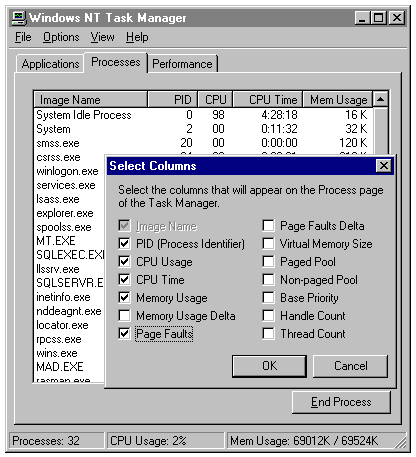
Plummer recalls writing the first version in his den around 1994. He wanted a simple way to see which programs were running, how much CPU and memory they were using, and which one was causing trouble. It was a side project, not an assigned Windows feature. He even considered selling it as shareware.1
The version he wrote at home gathered performance information through the Windows registry. Once he brought it into Microsoft, he could replace that setup with internal Windows NT system calls. The program became faster and more responsive.2
Then Dave Cutler tried it.
Cutler was leading the Windows NT team and had a reputation for being difficult to impress. By Plummer’s account, Cutler approved adding the utility to the Windows source tree. Plummer donated it to Microsoft, and Task Manager eventually shipped with Windows NT 4.0 in 1996.3
That is a remarkably informal beginning for a tool that millions of people would later treat as Windows emergency equipment.
A small program built for bad situations
Task Manager had to work when other software did not. If the desktop shell was stuck or the computer was running out of resources, opening another large, fragile application would not help much. Plummer designed Task Manager to start without Explorer and to fall back to a reduced mode when memory was scarce. Windows also provided several ways to launch it, including through the Ctrl+Alt+Del screen.4
The original program was tiny. Plummer remembers it being under 100 KB. He avoided pulling in the standard C runtime and paid close attention to how much work the interface was doing. When the window was resized, Task Manager redrew only the rows and columns that had changed. That kept the graphs and lists from flickering.
These details are easy to skip because the program looked so plain. There was no launch campaign built around its resizing code. Users simply dragged the edge of the window and it behaved properly.
Not every idea survived. An early version used digital, seven-segment-style meters. They looked a bit like the numbers on a calculator. Plummer dropped them after running into problems adapting the design for different languages and writing directions.1
The best story from the early development may be the one involving his home telephone number.
While tracking down a bug that could make CPU usage add up to more than 100 percent, Plummer put his number in an error message so testers could call him if they saw it. The message made its way into a beta build. It is hard to picture anyone doing that now, but it fits the rest of the story: one programmer, one small utility, and a very direct interest in knowing when it broke.5
Task Manager grew far beyond that first version. Microsoft added performance graphs, services, startup controls, user sessions, memory dumps, and plenty more. The current application is not a museum piece from Windows NT, but the basic job is still recognizable. When Windows starts acting strangely, Task Manager tells you what is running and gives you a chance to do something about it.6
Task Manager, again
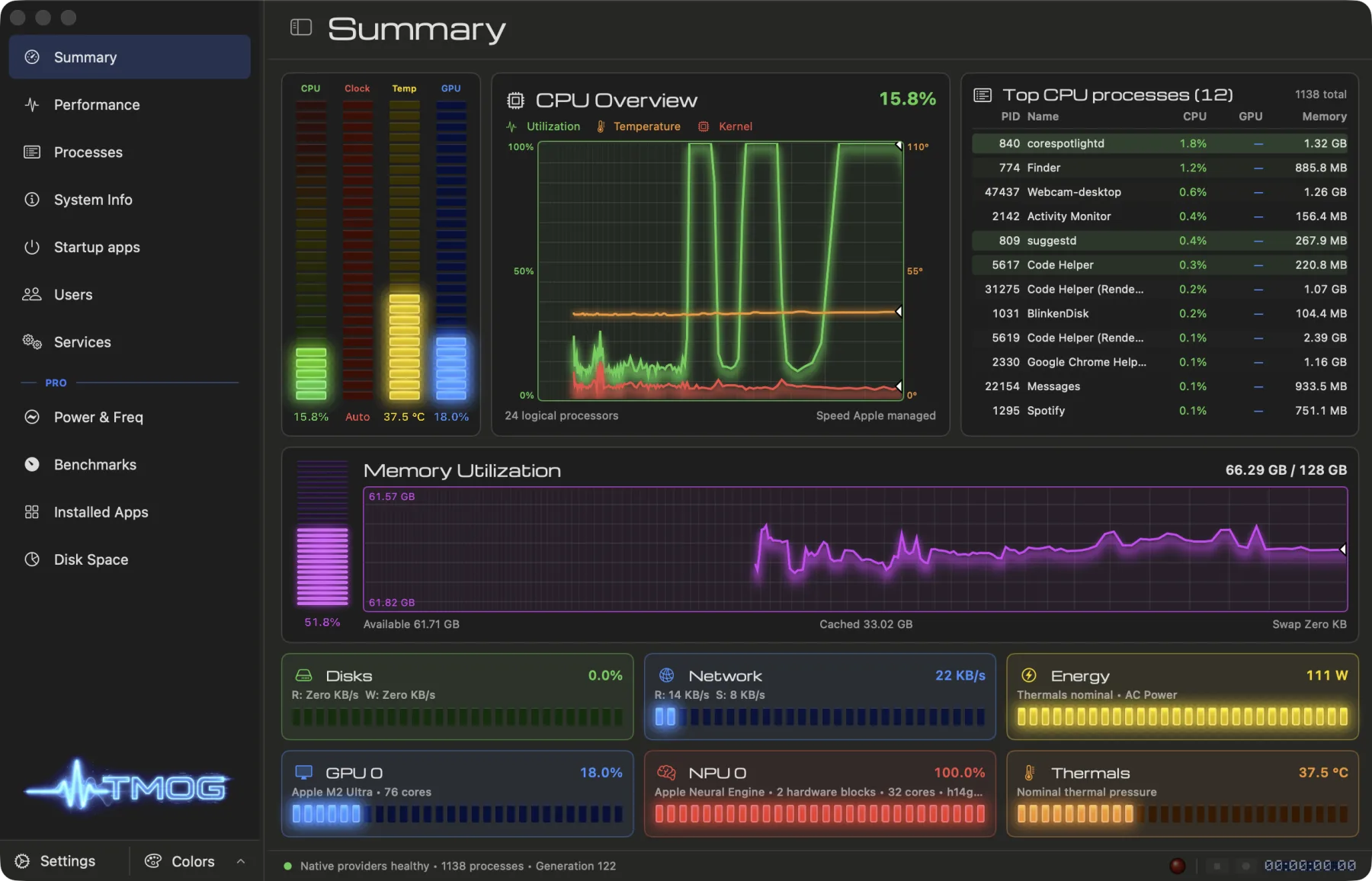
In August 2026, Plummer introduced TMOG, or Task Manager OG. It is a new task manager for Windows, macOS, and Linux. The current Beta2 uses a shared C++ core with a native interface for each operating system: Win32 on Windows, Swift and AppKit on macOS, and Qt 6 on Linux.7
TMOG began after an argument about whether someone could “vibe code” Microsoft Word. Plummer did not end up rebuilding Word. He returned to the kind of program he knew unusually well.
This time, an AI coding agent was involved. Reports say Plummer supplied a 107-page specification before the first coding pass. The Register described a 3.5-hour first pass using Fable, while Tom’s Hardware reported roughly 4.5 hours for early versions in Claude Code, followed by more refinement.8
I do not think the stopwatch is the most interesting part of TMOG. Those reports describe early milestones, not all the work required to reach the Beta2 people can download today. The public application source is private, so there is no clean way for an outsider to separate the first generated code from later fixes, testing, platform work, and human decisions.8
The more revealing number is 107 pages. Plummer did not sit down, type “make Task Manager,” and hope for the best. He arrived with a long description of what the program should do. AI may have accelerated the implementation, but it still needed direction from someone who had spent decades thinking about this particular kind of software.
That history makes TMOG more fun than a generic vibe-coding demo. Plummer’s first Task Manager started as a utility he wanted on his own computer. It became part of Windows and stayed there for thirty years. Now he has gone back to the same problem with different operating systems and a very different programming tool.
What I like about the story is that Plummer still seems interested in the same basic question: what is this computer doing, and why is it doing that?
Footnotes
-
Dave Plummer, “I wrote Task Manager and I just remembered something…”, Reddit, 2020. Plummer’s retrospective is the source for the den, approximate 1994 date, early display, size, resilience, and resizing details. ↩ ↩2
-
Lex Fridman, Dave Plummer interview transcript, 2025, especially 00:37:18–00:42:02. Plummer explains why he built the utility and how the home prototype changed after he brought it into Microsoft. ↩
-
Richard Speed, “‘I wrote Task Manager’: Ex-Microsoft programmer Dave Plummer spills the beans”, The Register, 2020; Microsoft, “The History of Microsoft — 1996”; Special Edition Using Windows NT Server 4.0, Chapter 1, contemporary interface screenshot. These sources carry Plummer’s Cutler, shareware, and donation account, establish Windows NT 4.0’s July 1996 release-to-manufacturing date, and document the pictured interface. ↩
-
Plummer, Reddit retrospective; Raymond Chen, “Why does it take Task Manager longer to appear when you start it from the Ctrl+Alt+Del dialog?”, Microsoft DevBlogs, 2012. ↩
-
Richard Speed, “Microsoft’s Task Manager turns 30: Original coder celebrates”, The Register, 2025. This carries Plummer’s account of the CPU assertion and telephone number. ↩
-
Microsoft Learn, “Troubleshoot processes by using Task Manager”, updated February 12, 2026. ↩
-
Dave Plummer, TMOG launch post, August 23, 2026; “Windows Task Manager’s Creator Rebuilt It 30 Years Later”, Dave’s Attic, August 2026; Plummers’ Software LLC, TMOG homepage and Beta2 release notes, verified August 30, 2026. ↩
-
Richard Speed, “Windows Task Manager creator builds macOS, Linux versions”, The Register, August 24, 2026; Mark Tyson, “Windows veteran’s ‘vibe-coded’ Task Manager now also runs on Mac and Linux”, Tom’s Hardware, August 25, 2026; Plummers’ Software LLC, TMOG Feedback repository README. ↩ ↩2